Your product pages aren’t just selling to humans anymore; they’re being evaluated, summarized, and cited by AI. Welcome to the era of AI-driven search engine optimization, where tools like ChatGPT, Claude, and Google’s AI Overviews help decide what gets seen, trusted, and clicked.
These platforms are already reshaping how people discover products, and their influence is impossible to ignore.
If your product pages aren’t optimized for how large language models (LLMs) interpret, extract, and present information, you’re quietly losing visibility in a search environment that’s evolving at lightning speed. SEO still matters, but it needs some AI revamping.

The good news? You don’t need to start from scratch. You just need to adapt your strategy. Below are five tips on how to turn your product pages into content that AI can understand, trust, and retrieve, both now and as search continues to evolve.
1. Structure Content for How AI Thinks
AI models evaluate not just what your page says but how it says it. Applying LLM SEO principles means breaking information into clear, scannable sections that AI can parse, summarize, and reference in answers.
If your product description is one long paragraph with no clear segmentation, you’re making it harder for an AI model to understand and retrieve your content.
Also, AI models require specific information to generate helpful answers. Generic phrases won’t cut it. Break information down into clear sections that include:
- Product Overview: What it is (product dimensions, weight, and materials) and who it’s for
- Features and Specs: Battery life or other performance benchmarks, and use bullet points for quick parsing
- Use Cases: Customer reviews with actual use cases or comparisons with similar products are especially helpful for AI to understand scenarios where your product fits
- FAQs or Buyer Considerations: Answer common reasoning-path questions
Even better, use comparison tables or pros/cons summaries. This structured format is what LLMs love because they’re easy to parse and cite.
This content formatting aligns with how LLMs perform chain-of-thought reasoning by breaking down user intent, filtering options, and recommending outcomes. When your content mirrors that structure, you become easier to cite.
2. Include Semantic and Structured Data
Keywords still matter, but semantic clarity and structured signals are what guide AI-generated answers.
Use schema markup wherever possible: Product, Review, FAQ, and Offer schemas are critical for helping AI understand what your page contains and how to categorize it.
Even more important is how your language reads. Instead of cramming the phrase “wireless earbuds” 15 times, clearly state:
- What makes them wireless (e.g., Bluetooth 5.3)
- Who they’re designed for (e.g., runners, commuters)
- What problem do they solve (e.g., long battery life, comfortable fit)
This creates a more complete semantic footprint. LLMs like ChatGPT and Claude evaluate these layers when deciding what content to pull into summaries or recommend in product comparisons.
3. Use Confident, Clear Language
Vague language kills your chances of being featured in AI outputs. AI doesn’t want hedging; it wants clarity.
Compare these two statements:
- “This device might help with sleep.”
- “Clinical studies show this device improves sleep quality in adults when used nightly.”
The second is specific, confident, and verifiable. It’s also more likely to be cited by an AI model attempting to provide accurate and trustworthy information.
Avoid weak modifiers such as might, possibly, could, and arguably.
Instead, ground your claims in specifics, such as metrics, comparisons, guarantees, and user data. Confidence enhances your trust signals, which AI considers when ranking.
4. Prioritize Use-Case Content Over Brand Storytelling
Telling your brand’s origin story is fine, but that’s not what AI search cares about. Product pages need to emphasize utility, not personality.
LLMs work through reasoning chains like: “Who is this for? What does it solve? Is there evidence it works?” If your page doesn’t support that logic path, it gets skipped.
Give clear use cases in the form of “If you’re X, this product helps you Y.” Here are some examples: “If you’re a remote worker, this standing desk helps alleviate back pain during long hours,” and “For travelers, the compact size fits easily into carry-on luggage without sacrificing power.”
These answers help LLMs process your product within the user context, making you more retrievable when someone searches conversationally (e.g., “What’s the best portable charger for international travel?”).
5. Don’t Ignore Visual Context
AI models are increasingly trained on visual data, and platforms like Google’s AI Overview are integrating image recognition.
Make sure your product images are placed near relevant content sections. They should have descriptive alt text (e.g., “White ceramic coffee maker with bamboo handle”), and support the same claims made in text (e.g., show the item in use).
Images won’t carry your SEO alone, but when you pair them with well-structured content, they strengthen your message and give AI clearer signals to work with.
Don’t Forget to Refresh Your Content Regularly
LLMs like ChatGPT and Claude prioritize information that appears current and actively maintained. Static product pages that haven’t been updated in two years may appear stale even if the product itself remains unchanged.
Make a habit of updating:
- Review quotes or testimonials
- Availability, pricing, or shipping info
- Any stat-based claims (“#1 bestseller in 2024” should become “2026” if still relevant)
Even subtle changes signal freshness and can keep you in the AI citation loop longer.
Build for the Future with AI Search
AI-driven search isn’t coming; it’s already shaping how people discover products today. If your product pages are vague, disorganized, or trying to be clever instead of clear, you risk being overlooked by the very tools your customers rely on. Implementing SEO for AI search ensures that your content is structured, clear, and discoverable by both humans and AI systems.
Use these tips to create product pages that work for both humans and AI. Visibility won’t come from gaming the system; it will come from giving AI the context it needs to show why your product is the answer.
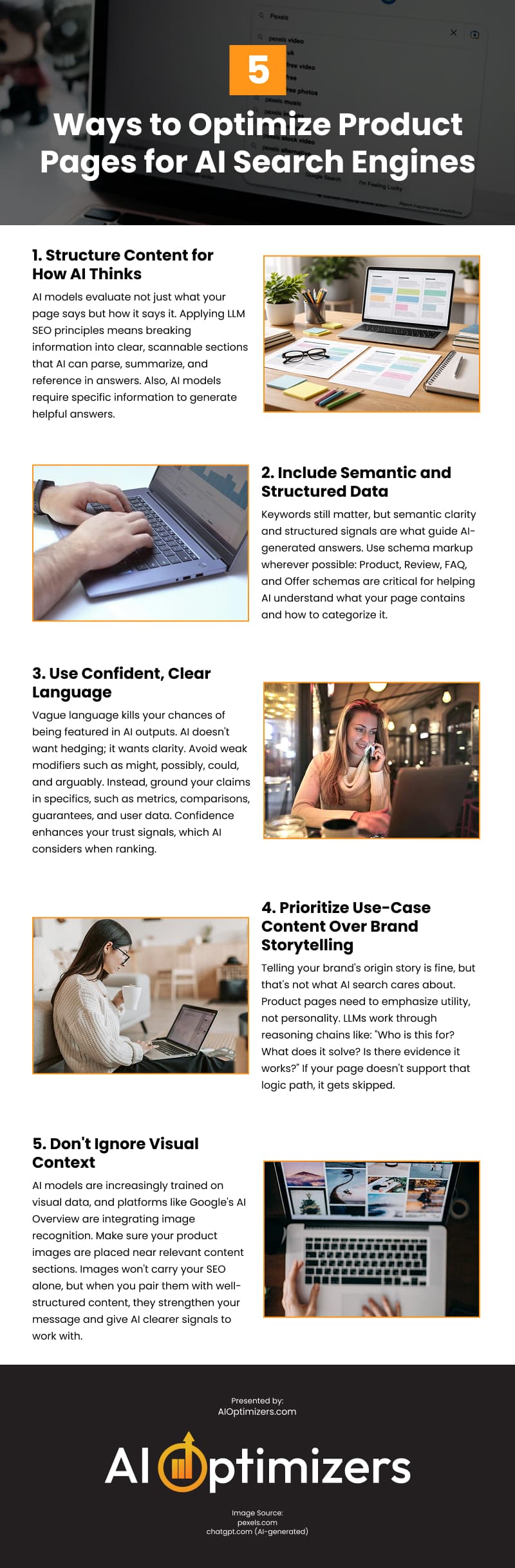
Infographic
To stay competitive in today’s search landscape, optimizing product pages for large language models is essential. This infographic shares five practical tips to make your product pages more AI‑friendly and effective as search continues to evolve.