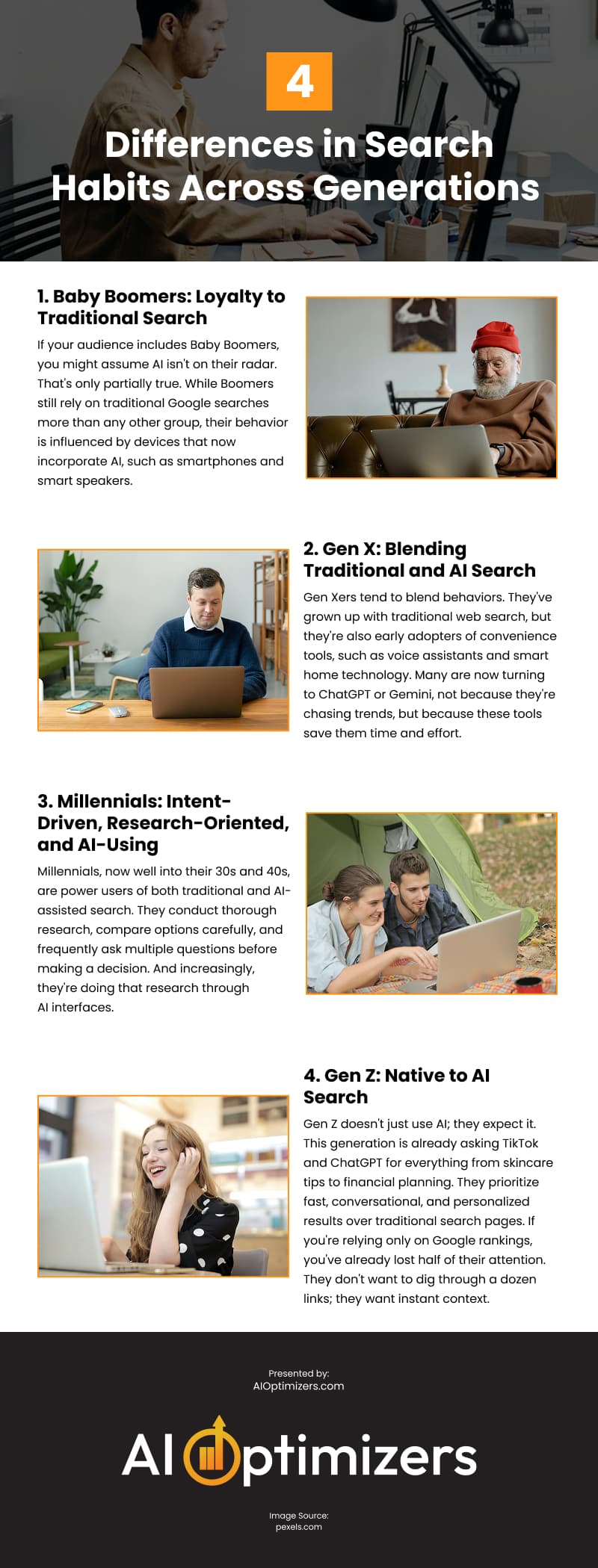
We’ve said it before: search is evolving.
But who’s doing the searching actually matters a lot. Different people receive different results from AI, and this can impact how visible your brand is online.
Search isn’t the same for everyone, especially now that each generation uses different devices, apps, and has different expectations when looking for info.
With AI tools like ChatGPT, Gemini, and Perplexity becoming go-to search helpers for younger generations, it’s time to rethink what SEO really means. How each generation searches affects AI results in different ways, and that can make a big difference in how your brand shows up online.

Baby Boomers: Loyalty to Traditional Search
If your audience includes Baby Boomers, you might assume AI isn’t on their radar. That’s only partially true. While Boomers still rely on traditional Google searches more than any other group, their behavior is influenced by devices that now incorporate AI, such as smartphones and smart speakers.
Baby Boomers often prefer straightforward results, such as links to trusted news outlets, service providers with clean reviews, or high-ranking websites. They’re less likely to use voice search, but may interact with AI assistants indirectly, such as asking Siri or Alexa for local businesses or product details.
For your brand, this means maintaining high-quality, structured content, as positive authority signals still matter. However, you must also ensure that AI assistants, which pull from Google’s data (or from Gemini), can parse your site and offer the most relevant answers.
Gen X: Blending Traditional and AI Search
Gen Xers tend to blend behaviors. They’ve grown up with traditional web search, but they’re also early adopters of convenience tools, such as voice assistants and smart home technology. Many are now turning to ChatGPT or Gemini, not because they’re chasing trends, but because these tools save them time and effort.
A Gen Xer might search Google for “best tax software” but then follow up by asking ChatGPT, “Which of these is easiest for freelancers?” That means you’re competing in two arenas: the indexed web and AI-generated summaries.
If your content doesn’t answer layered or contextual questions, or if your brand lacks semantic structure, you’ll miss the second half of that buyer journey. You’re not just competing for rank; you’re competing for inclusion in the next layer of the search funnel, where AI reshapes the results.
Millennials: Intent-Driven, Research-Oriented, and AI-Using
Millennials, now well into their 30s and 40s, are power users of both traditional and AI-assisted search. They conduct thorough research, compare options carefully, and frequently ask multiple questions before making a decision. And increasingly, they’re doing that research through AI interfaces.
Many Millennials now trust generative search to give them a high-quality overview before diving deeper. If they ask, “What’s the best CRM for solopreneurs?” they’re not looking for a 10-link SERP. They want a summary, a breakdown, and maybe a recommendation from ChatGPT, Claude, or Perplexity.
To reach them, you need content that speaks their language and speaks to the LLM. That means crafting pages with clear intent signals, clean data, FAQ sections, and structured information. If your content isn’t designed for AI comprehension, it may not be included in the summary, regardless of how well it ranked in the past.
Gen Z: Native to AI Search
Gen Z doesn’t just use AI; they expect it. This generation is already asking TikTok and ChatGPT for everything from skincare tips to financial planning. They prioritize fast, conversational, and personalized results over traditional search pages.
If you’re relying only on Google rankings, you’ve already lost half of their attention. They don’t want to dig through a dozen links; they want instant context. And they’re not searching by keywords. They’re asking full, conversational prompts like, “What are the best laptops for digital art that aren’t too expensive?”
To earn placement in the results they see, your content must match that format. Your copy should reflect how people naturally ask questions. Your product and service pages need schema markup that AI can easily understand. And your site’s authority across external platforms, such as Reddit, YouTube, or trusted third-party blogs, matters more than ever.
How These Differences Affect AI Search Performance
Each generation uses AI in different ways, but they all lead to the same outcome: discovery doesn’t happen the way it used to. It’s less about browsing and more about receiving answers. That shift has massive implications for your content, SEO, and online strategy.
If you’re only optimizing for blue links and SERPs, you’re optimizing for the past. AI engines don’t just crawl sites; they summarize them. They reference what they trust. They look for structured, semantic clues about what your content means, not just what words it uses.
And since these engines tailor results based on how people ask questions, generational preferences directly influence what content gets surfaced. The more your content aligns with how each generation searches, the stronger your SEO for AI Search becomes.
What Can I Do to Stay Visible Across Generations?
Generational differences in search behavior aren’t just fun marketing facts. They’re strategic signals. If you want your brand to stay discoverable in the age of AI search, you need to align your strategy with the habits of each audience segment.
Here are three things you can start doing now:
- Map generational queries to content: Review your analytics and see how different age groups phrase their searches. Adjust your page titles, headers, and FAQ content to mirror those patterns.
- Structure for LLMs: Utilize schema markup, clean metadata, and natural language that aligns with conversational prompts. AI doesn’t “see” your site like humans do—it reads your structure.
- Balance SEO with LLMO: Traditional SEO still matters, but you must now optimize for how large language models retrieve, interpret, and present your content. That’s the foundation of GEO: Generative Engine Optimization.
AI Search Is Fragmented by Audience
The beauty of this shift is that AI isn’t making search monolithic. It’s making it more personal. Your job is to meet each generation where they are, whether that’s a Baby Boomer Googling a product, a Millennial asking Gemini for a product summary, or a Gen Z shopper typing a natural-language prompt into ChatGPT.
Optimize for who’s searching just as much as what they’re searching for, and you’ll build visibility that lasts across platforms, technologies, and generations.
Because the future of search isn’t about links, it’s about language and how well your brand speaks it.
Video

Infographic
Search behavior is no longer uniform, and generational differences now play a major role in how people discover brands across both traditional and AI‑driven platforms. Explore this infographic to see how search habits vary across generations.